
Planning for Learner Variability
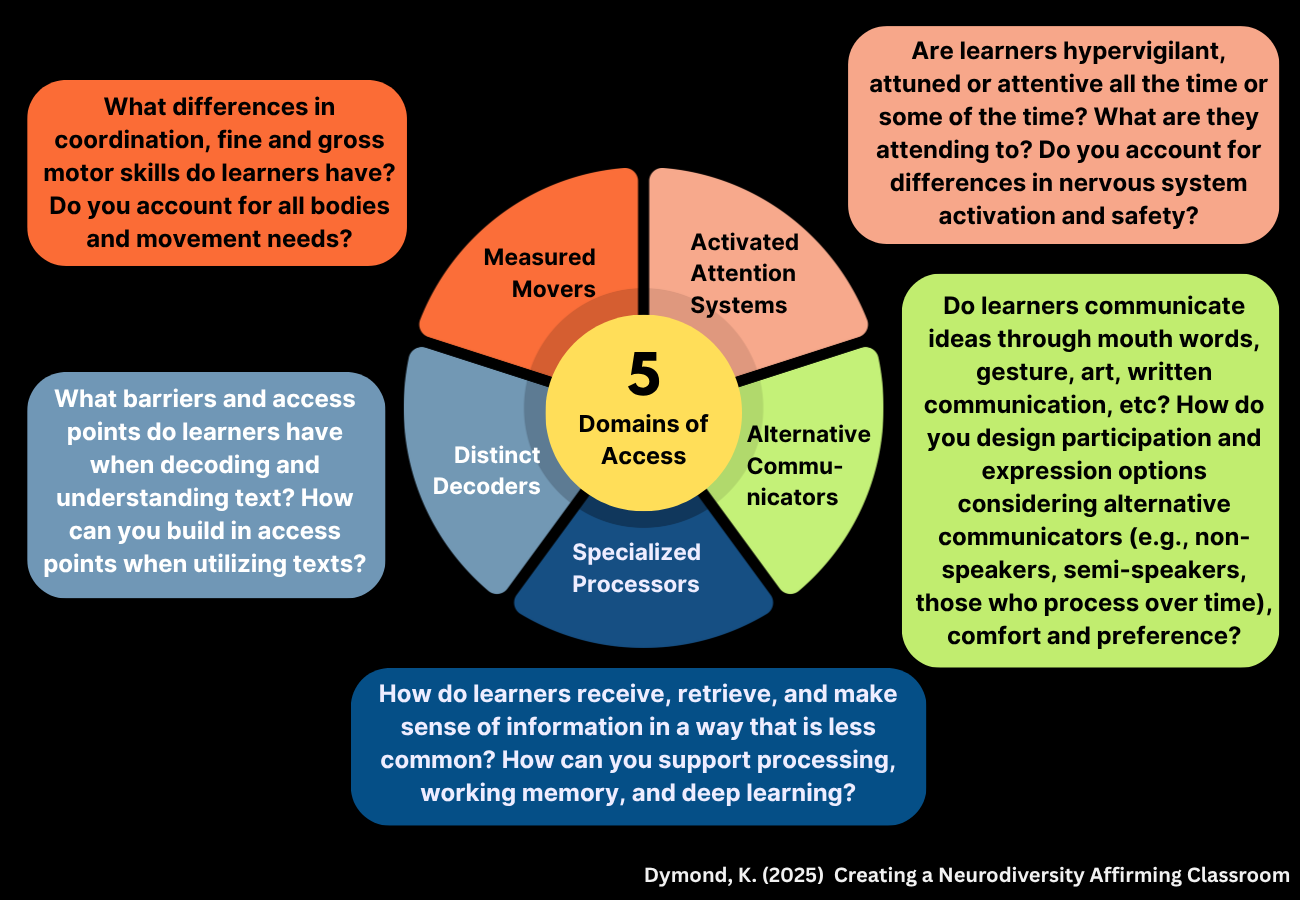
5 Domains of Access
(Image created by Aileen Santiago)
As a teacher, I often grappled with the problem with labels gatekeeping support. Especially knowing how access to labels is restricted (e.g., cost, waitlists, cultural perspectives, practitioner knowledge of presentations in a range of bodies), I believed my job was always to support the student in front of me.
I began thinking about five domains of supporting the range of learners I had experienced:
Activated Attention Systems
Are learners hypervigilant, attuned or attentive all the time or some of the time? What are they attending to? Do you account for differences in nervous system activation and safety?
Alternative Communicators
Do learners communicate ideas through mouth words, gesture, art, written communication, etc.? How do you design participation and expression options considering alternative communicators (e.g., non-speakers, semi-speakers, those who process over time), comfort and preference?
Specialized Processors
How do learners receive, retrieve, and make sense of information in a way that is less common? How can you support processing, working memory, and deep learning?
Distinct Decoders
What barriers and access points do learners have when decoding and understanding text? How can you build in access points when utilizing texts?
Measured Movers
What differences in coordination, fine and gross motor skills do learners have? Do you account for all bodies and movement needs?
Initially I used these categories as a way to to design the classroom setup - what I saw as part of the proactive part of Universal Design.
See the template of The Neurodiversity-Affirming Classroom Setup Checklist.
While my book gives more detail and considerations, this checklist can get you thinking about how to set your classroom up while considering the range of learners you may have in your class.
I really like the flexibility of the five domains, as learners may fall into multiple categories, sometimes at different times or in different subjects. Conceptualizing planning for the categories began inspiring me to think about learner experience and presence in anything I was planning. I began using these general categories to plan for potential barriers and access points that might come up in lessons, activities, and assessments.
You may wish to use my planning template, Barriers, Access Points, & Assessments, to think about each category in a particular subject, activity, or assessment. I hope it is helpful to your own planning with all in mind!
The Neurodiversity-Affirming Classroom Setup Checklist
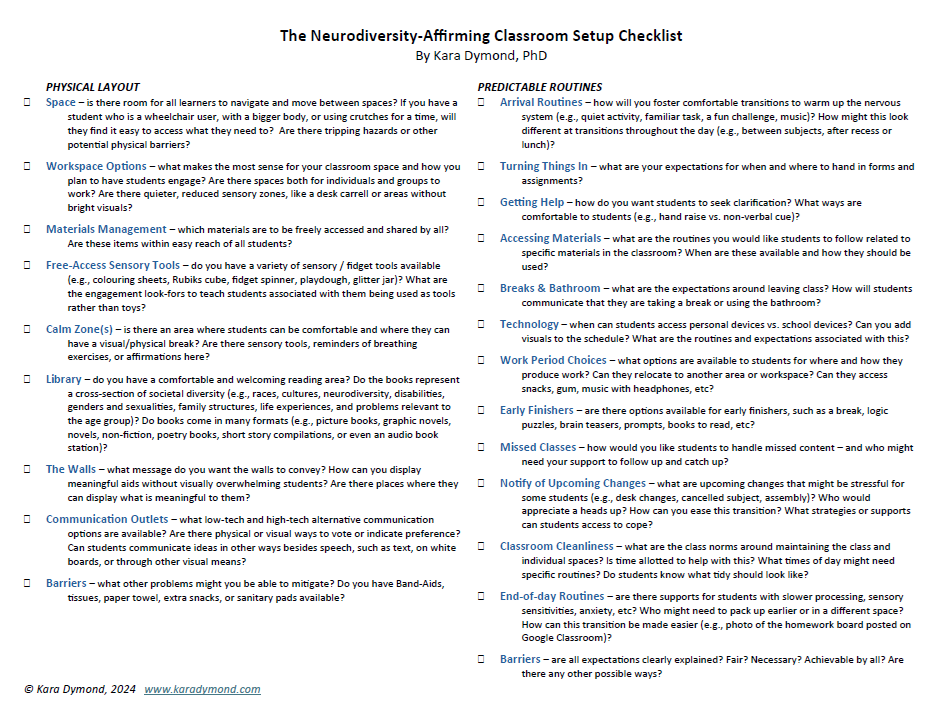
This checklist can help with thinking about the physical space and routines that may work for you.
Barriers, Access Points, & Assessments
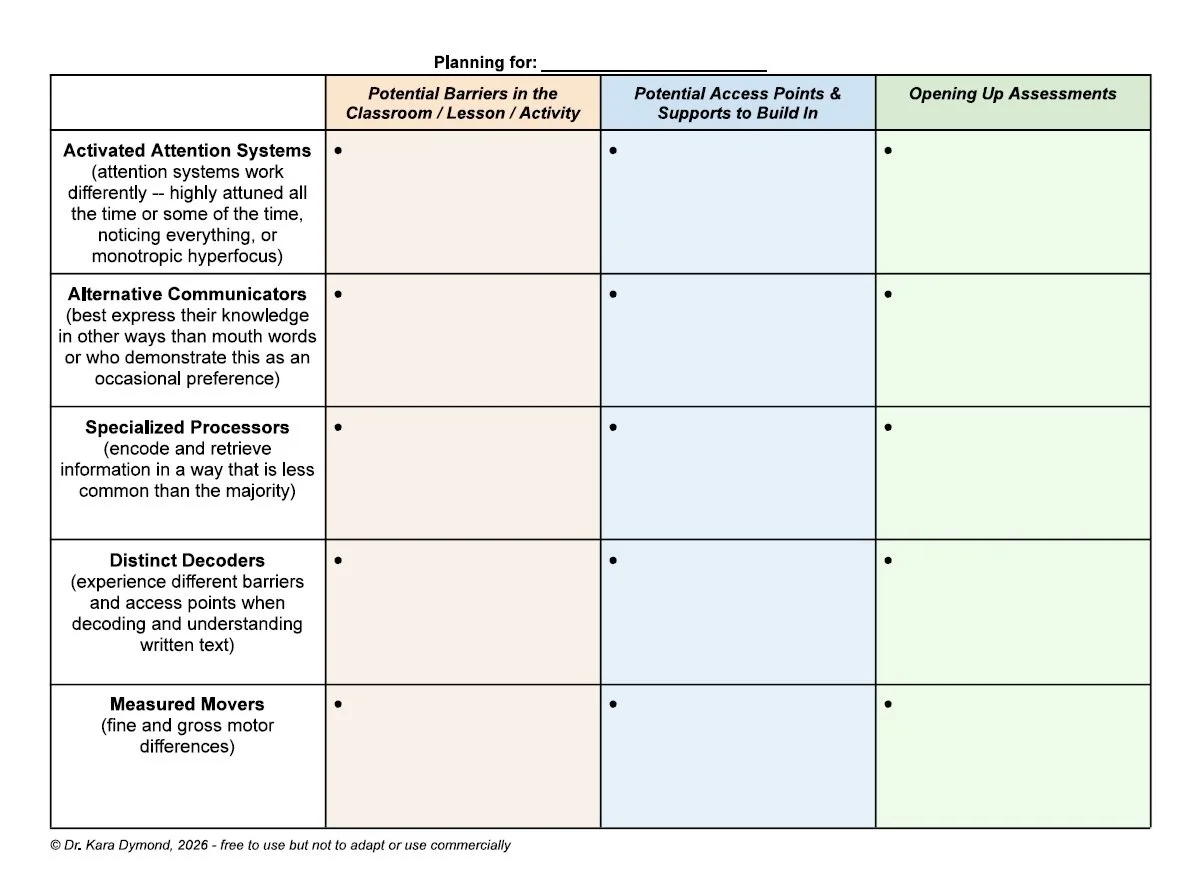
Use this to plan your lessons, activities, and assessments while thinking about each domain - or discuss with grade partners or other instructional teams.
I am a big believer that the heart of UDL (Universal Design for Learning) is radical responsiveness. Rather than just thinking proactively, model for students that we are all learning and taking feedback to improve. Solicit their ideas for how things can be made more accessible, which will help you to expand your understanding of learner experiences and possible access points (e.g., accessibility tools, executive functioning support, multimodality, options). As I always say, students are our best resource!
These organizers are free to use so long as proper attribution to (c) Dr. Kara Dymond remains visible.